Digital-Twin Sandbox: Paper Trading for Onchain Portfolio Management
Deploy vaults, set fees, paper trade on real market data, and generate ledger-backed tearsheets without client capital or regulatory exposure.

Wealth and portfolio management teams inside banks and regulated funds face growing pressure to understand onchain products, but the usual path offered to them is binary: stay on the sidelines, or accept real operational and regulatory exposure as the price of a first experiment. That framing treats readiness as something an institution either has or lacks. It is closer to a skill that can be rehearsed under controlled conditions first.
Orion's Digital-Twin Sandbox is built around that rehearsal idea: a regulated desk can deploy a vault, work through what an ERC-4626 product actually means in portfolio terms, configure fees, construct portfolios, paper trade on real market data, and generate institutional tearsheets, all without client capital or licensed live activity behind it.
The Readiness Problem
Most institutions do not lack curiosity about onchain markets. What they lack is a safe environment in which to rehearse.
A portfolio manager who wants to learn how vault shares, fees, and target allocations behave cannot simply open a live book to observe. Risk, compliance, and procurement will, correctly, block that. The result is a loop: the desk cannot learn without exposure, and the institution will not approve exposure without evidence that the desk has learned. Onchain readiness stalls because the only path on offer looks identical to production.
Traditional markets solved a version of this problem decades ago with paper trading and simulated books. Onchain vault products have largely skipped that intermediate step, asking institutions to move from a slide deck to live capital in a single jump.
Why Developer Sandboxes Are Not Enough
Infrastructure teams already know how to spin up forks, simulate transactions, and exercise protocol test deployments. Those tools matter for engineers verifying that code behaves correctly. They answer a narrower question than the one a portfolio desk is asking.
A transaction simulator confirms whether a call succeeds. It does not let a portfolio manager:
- deploy a product vault with fee waterfalls and share accounting;
- construct and update a target portfolio through a strategy composition interface;
- run paper trading against real market data as an ongoing book;
- produce NAV-aware performance reporting and tearsheets from that activity;
- carry the same product shape forward toward distribution once the institution is ready to go live.
Protocol test setups and local development environments are built for builders, not for the asset-management product itself. That is the specific gap Orion's Digital-Twin Sandbox is designed to close.
What the Digital-Twin Sandbox Is
The sandbox is a full product environment on testnet. Within it, a desk can:
- Deploy a vault in minutes.
- Learn ERC-4626 as a product: deposit and redeem flows, share supply, and NAV as the accounting backbone of the book.
- Set fees and product parameters the way a real offering would require.
- Construct portfolios and send target allocations.
- Paper trade on real market data.
- Generate tearsheets and track records from onchain activity.
Paper Trading Before Live Capital
No serious institution puts a new strategy in front of clients without a period of simulated or paper trading: the same interface and market conditions, without capital at risk. Orion's Digital-Twin Sandbox extends that same posture onchain.
Onchain markets add a layer of composability that traditional paper books do not fully capture, since a vault's behavior can depend on other onchain venues and contracts, not only on a private order book. That difference is real, and it is one reason a product-level sandbox is more useful here than a single transaction dry-run: a desk needs to rehearse the product as a whole, not only one trade in isolation.
Tearsheets as Ledger Views
Performance communication in traditional markets often starts as a report assembled after the fact from a book. On Orion, the tearsheet is a view on a ledger.
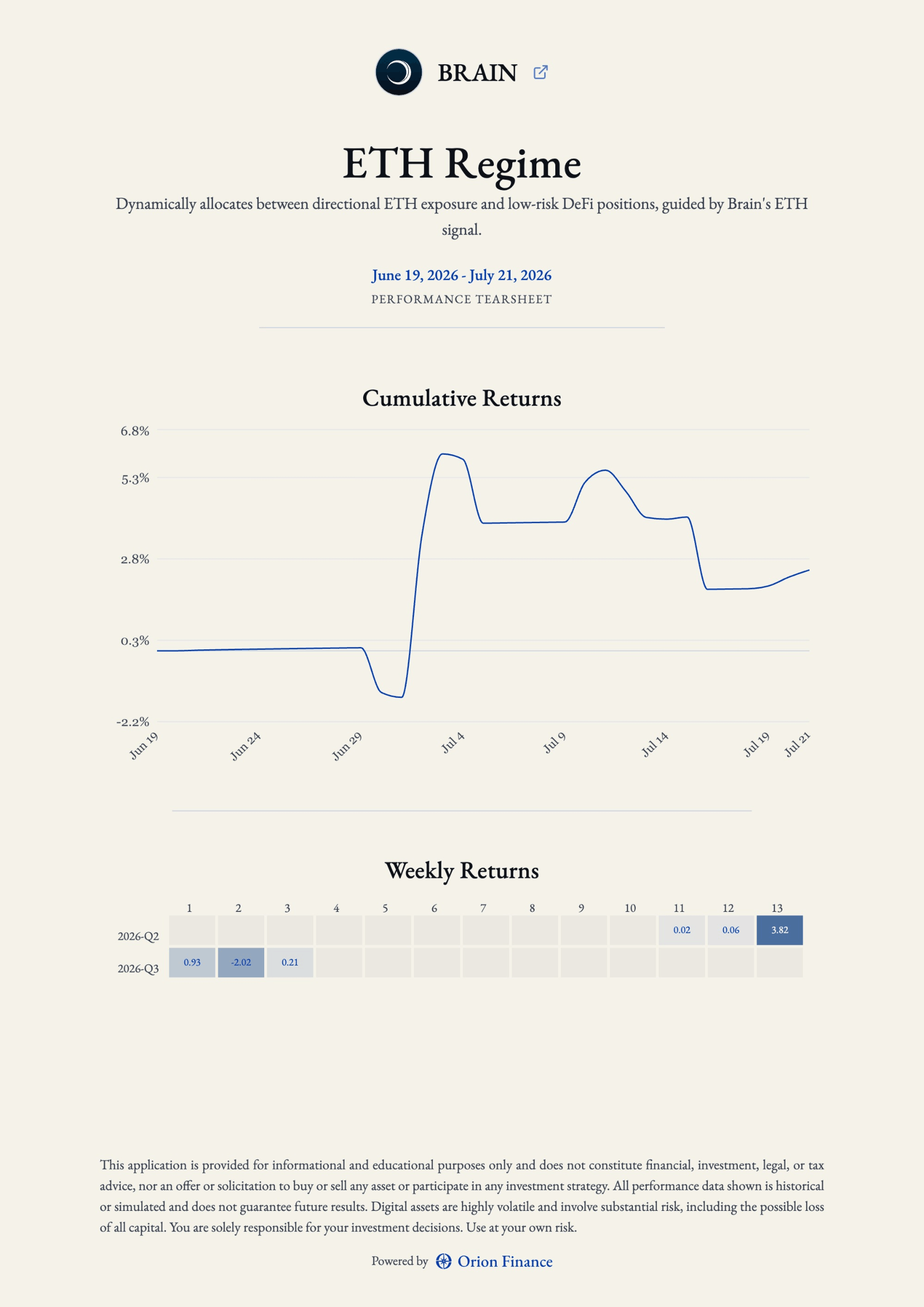
That distinction matters for institutions evaluating a track record. A backtest can be fit to history after the results are known. A sandbox tearsheet reflects activity that occurred onchain at known points in time, so by construction the series is point-in-time and out of sample relative to any model that motivated the strategy. It is closer in kind to a live track record than to an optimized backtest, though it still describes rehearsal activity rather than a book carrying client capital.
We have written separately about why headline returns and short samples can mislead allocation decisions in Beyond APY: Building a Meritocratic Framework for Onchain Performance. The same skepticism about backtest overfitting applies here, but runs in the opposite direction: ledger-backed sandbox performance is one way a desk accumulates evidence that risk teams and prospective allocators can inspect on its own terms, before any of it involves real client money. Readers interested in how issuance and administration functions migrate onchain more broadly may also find The ETP Issuer Stack, Onchain useful background.
References
- Orion Finance Research. Beyond APY: Building a Meritocratic Framework for Onchain Performance.
- Ethereum Improvement Proposals. ERC-4626: Tokenized Vault Standard.
- Interactive Brokers. Paper Trading.
Frequently Asked Questions
- What is Orion's Digital-Twin Sandbox?
- It is a product environment on the Sepolia testnet where institutions can deploy vaults, configure fees, construct portfolios, paper trade on real market data, and generate tearsheets and track records, all without client capital or licensed live activity.
- Is there regulatory risk in using the sandbox?
- Sandbox activity involves no client capital and no licensed activity, and it runs on a testnet rather than mainnet. That removes the specific exposure that typically blocks a first live onchain book. It does not remove an institution's own obligation to review the sandbox against its internal policies; it simply gives that review a low-risk, concrete object to examine.
- What is an ERC-4626 vault in plain terms?
- It is a standardized onchain fund wrapper: investors deposit assets and receive shares, the vault accounts for the pool's value as NAV, and redemptions burn shares for underlying assets. The sandbox lets a portfolio team operate that product shape directly rather than learn it only from a specification document.
- How is a sandbox track record different from a backtest?
- A backtest is a historical simulation that can be fit to data after the outcome is known. A sandbox tearsheet is generated from ledger activity that actually happened at known times, so the performance path is point-in-time and out of sample by construction. See Beyond APY for why sample design and statistical confidence matter when institutions evaluate any track record, sandbox or live.
- Does paper trading in the sandbox use simulated prices?
- No. The sandbox paper-trades against real market data, so the market conditions a desk observes are the same ones a live book would face. What differs from a live book is that no client capital moves and no licensed activity occurs.
- Can a vault built in the sandbox be moved to production later?
- The sandbox is designed so the same product shape, vault configuration, fee structure, and portfolio logic, carries forward when an institution is ready to go live. That continuity is the point of rehearsing in a product environment rather than a generic developer testnet.
- Who inside an institution typically uses the sandbox first?
- Portfolio managers and product teams tend to use it to learn the mechanics of vault shares, fees, and rebalancing. Risk and compliance teams typically use the resulting tearsheets and configuration as the concrete artifact for their own internal review, rather than reviewing a live book directly.
- Does a good sandbox track record guarantee similar live performance?
- No. A sandbox tearsheet is evidence about how a strategy behaved under real market conditions during the rehearsal period; it is not a forecast of how the same strategy will perform once client capital and live execution frictions are introduced. Reading it as a reference point rather than a promise is closer to how the desk itself should treat it before deciding to go live.