Onchain Execution: Gas, Venue Selection, and Netting in Multi-Vault Rebalancing
How Orion's framework supports capital-efficient strategies with intent-based execution, venue selection, and order netting.

For a manager deploying strategies on Orion, the relevant question is not whether onchain execution is cheap in the abstract, but which cost driver dominates at the manager's own scale, venue mix, and netting efficiency.
Two Components of Execution Cost
Gas is the cost of expressing a rebalance onchain: telling the protocol what the target portfolio should be. Execution cost is the cost of achieving it: moving assets through liquid venues to reach the target exposure. Orion separates these two costs structurally, not only conceptually: a manager submits an intent, and the protocol handles settlement and routing through a curated investment universe.
Beyond simplifying the manager's side of the process, that separation is also an economic design choice. A manager incurs gas only at intent submission; settlement and routing are handled downstream by the protocol, and their cost does not appear as a separate line item on the manager's side.
Gas Costs
A useful view of gas cost is not gas price alone. The dollar expense a manager actually feels is the product of network congestion (gas price in gwei) and the ETH/USD rate at the time of execution; either variable moving independently changes the bill.
The chart below plots daily gas price, ETH/USD, and the resulting USD cost per million gas units over a twelve-month window.
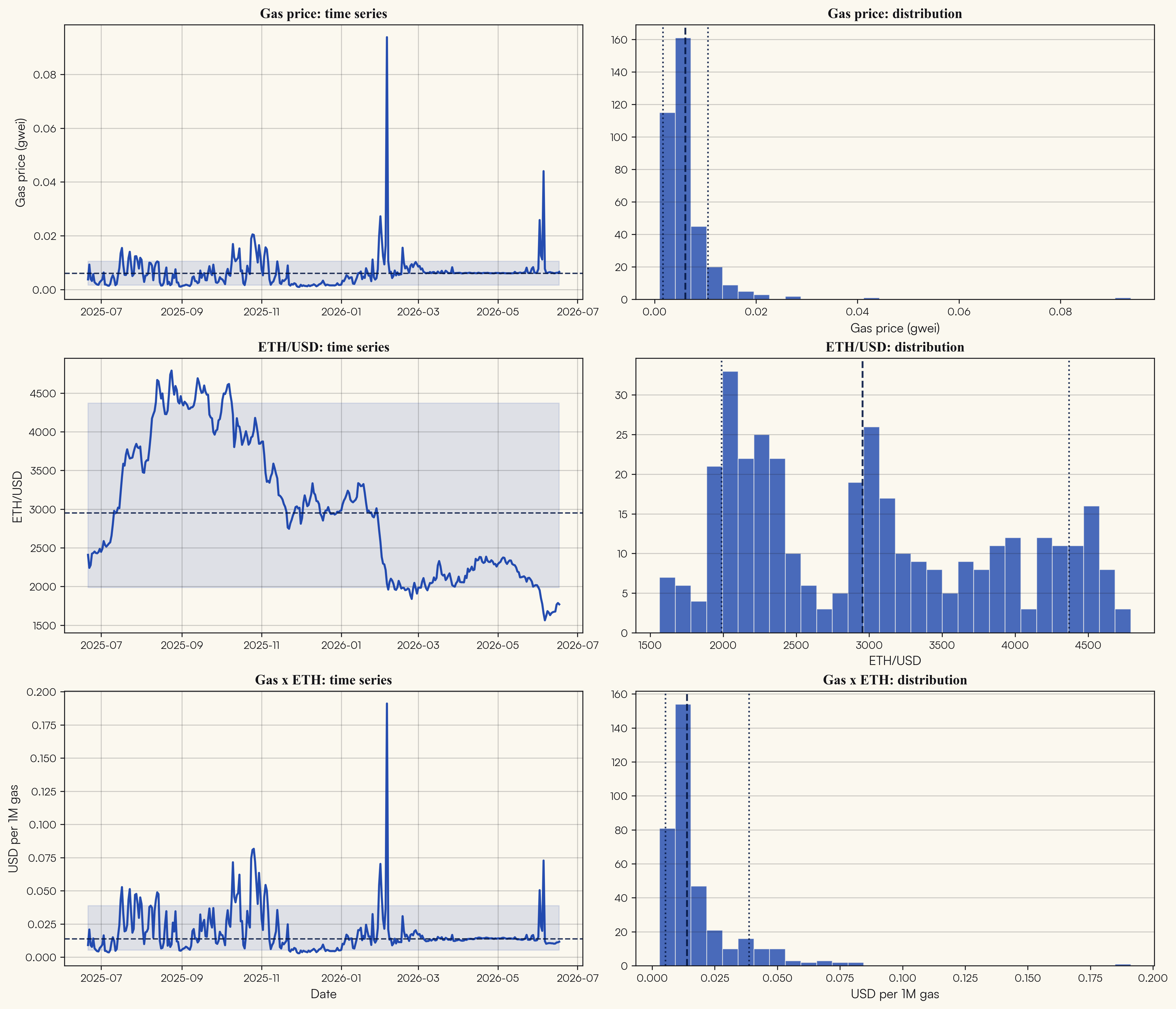
The baseline regime observed here is favorable: gas spends most of the sample at low levels, and even when ETH is elevated, the joint cost per gas unit stays manageable. Ethereum.org's 2026 builder overview notes that mainnet is no longer priced like a permanently congested chain, a structural change relevant to portfolio programs that batch state transitions on Layer 1 rather than routing operational logic to rollups by default.
Intent Submission as the Manager's Gas Boundary
On Orion, the manager-facing gas obligation is confined to intent submission: the Layer-1 call that expresses target weights across vaults. Settlement, routing, and swap execution occur downstream and do not appear as separate gas costs on the manager's side.
The chart below maps submission cost in USD against intent size, a proxy for rebalance complexity, with confidence intervals reflecting the influence of other variables.
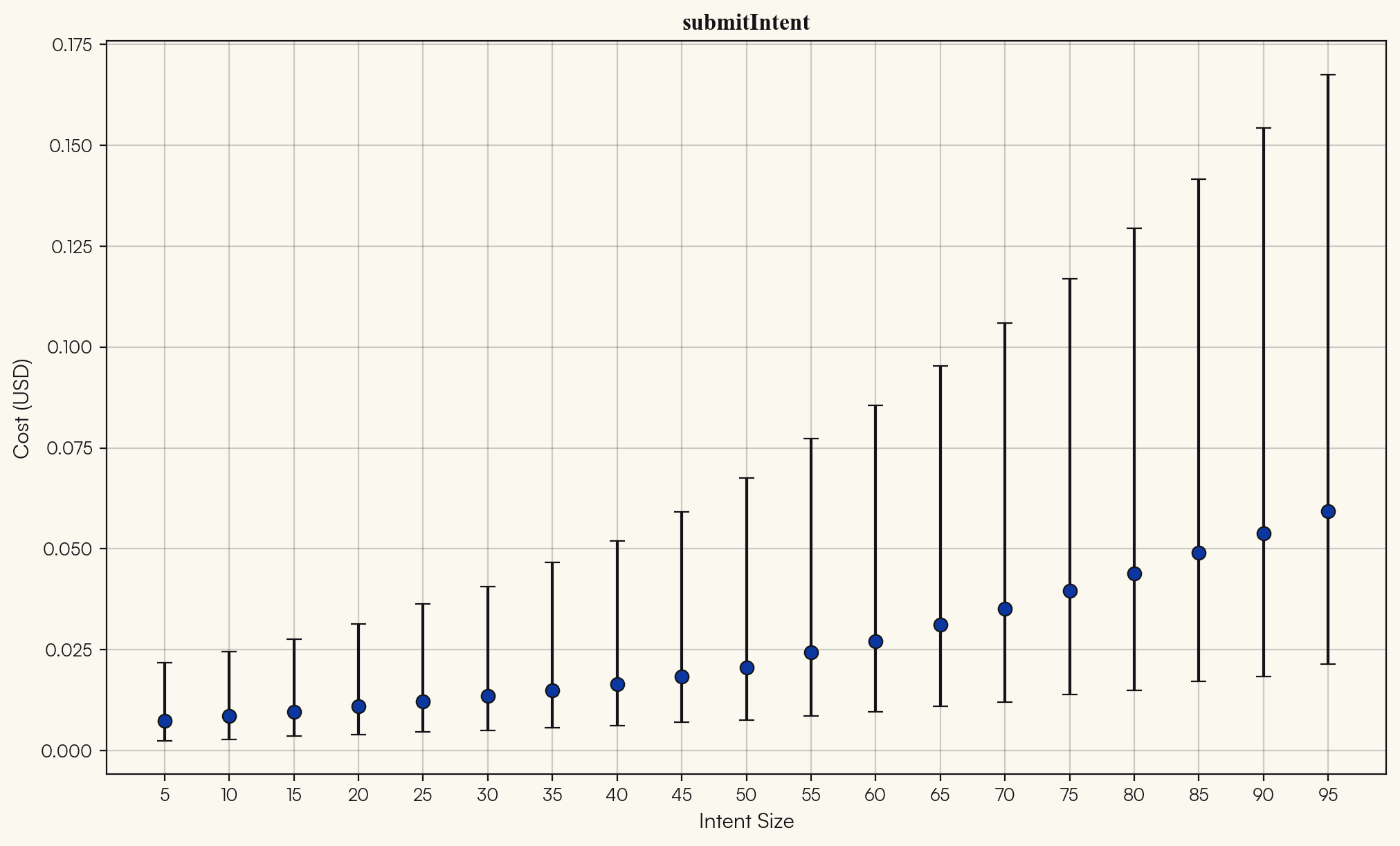
Even at large intent sizes, submission cost remains in the range of cents rather than dollars. Cost does rise with complexity, and the upper uncertainty band widens at scale, but the absolute level stays negligible relative to vault NAV. For systematic rebalancing programs, Layer-1 gas is not the constraint on rebalancing decisions.
The practical implication is that execution economics are dominated by liquidity, not by Layer-1 overhead, which shifts the manager's attention toward venue selection.
Execution Across the Investment Universe
Residual portfolio flow, whatever is left after any internal netting, is routed through three venue types. The costs below use η = 0, meaning no internal netting, to isolate venue behavior on its own.
| Venue | Role |
|---|---|
| Uniswap v3 | Continuous AMM from pool state |
| Bebop | Professional market-maker RFQ |
| CoW Swap | Batch auction |
Cost per unit of capital (%):
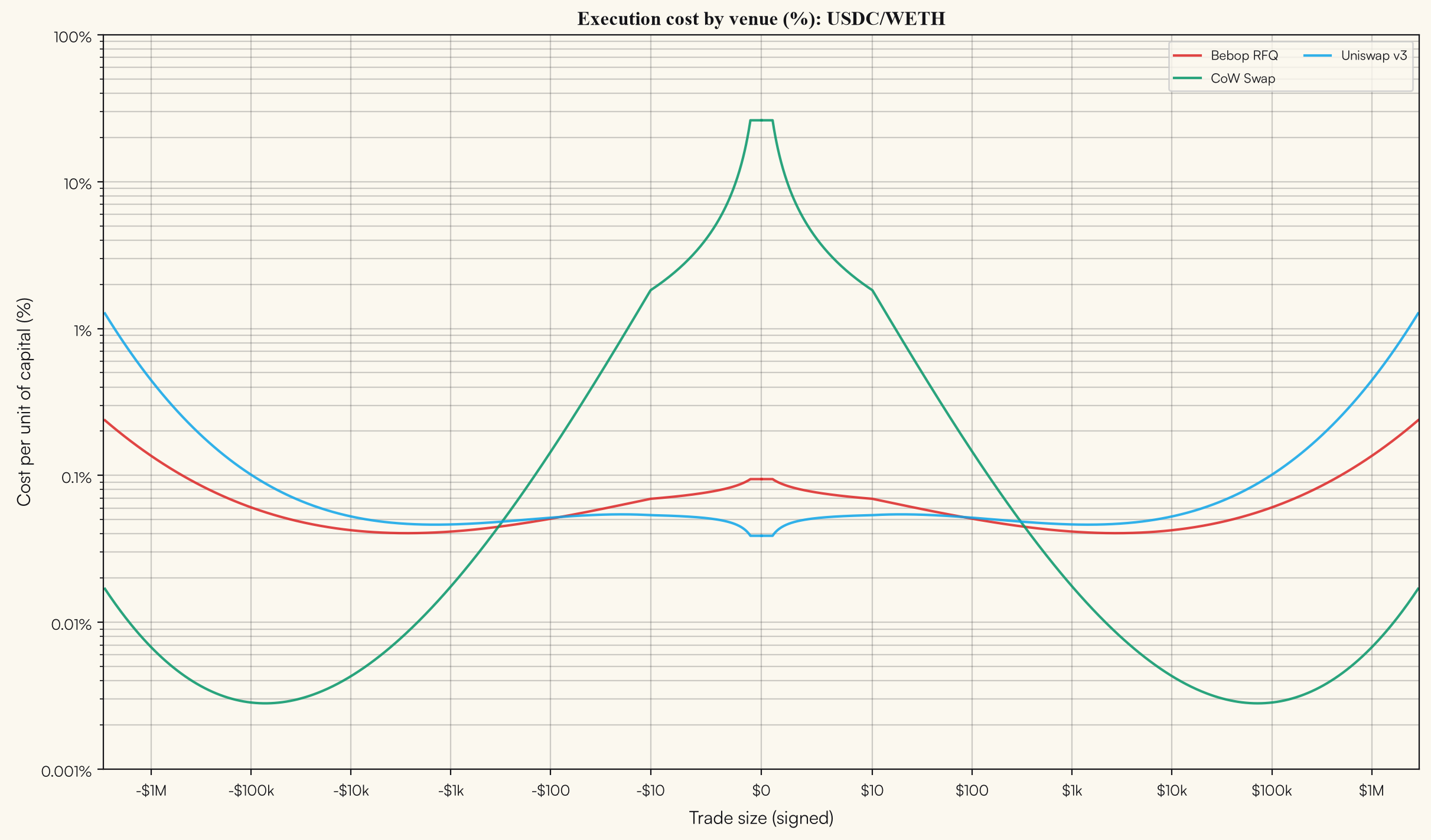
Uniswap v3 shows the classic fee-floor plateau, then convex slippage at size. Bebop's RFQ pricing is relatively flat in percentage terms, with less size dependence than the AMM tail. CoW Swap is U-shaped: elevated percentage cost at very small notionals, where fixed overhead dominates, then compression at mid-to-large sizes, where batching and solver competition improve terms. CoW is not the cheapest venue at every size, but in the rebalance-relevant band it undercuts the other two. Venue selection is a first-order decision for systematic exposure adjustments.
Total execution cost (USD):
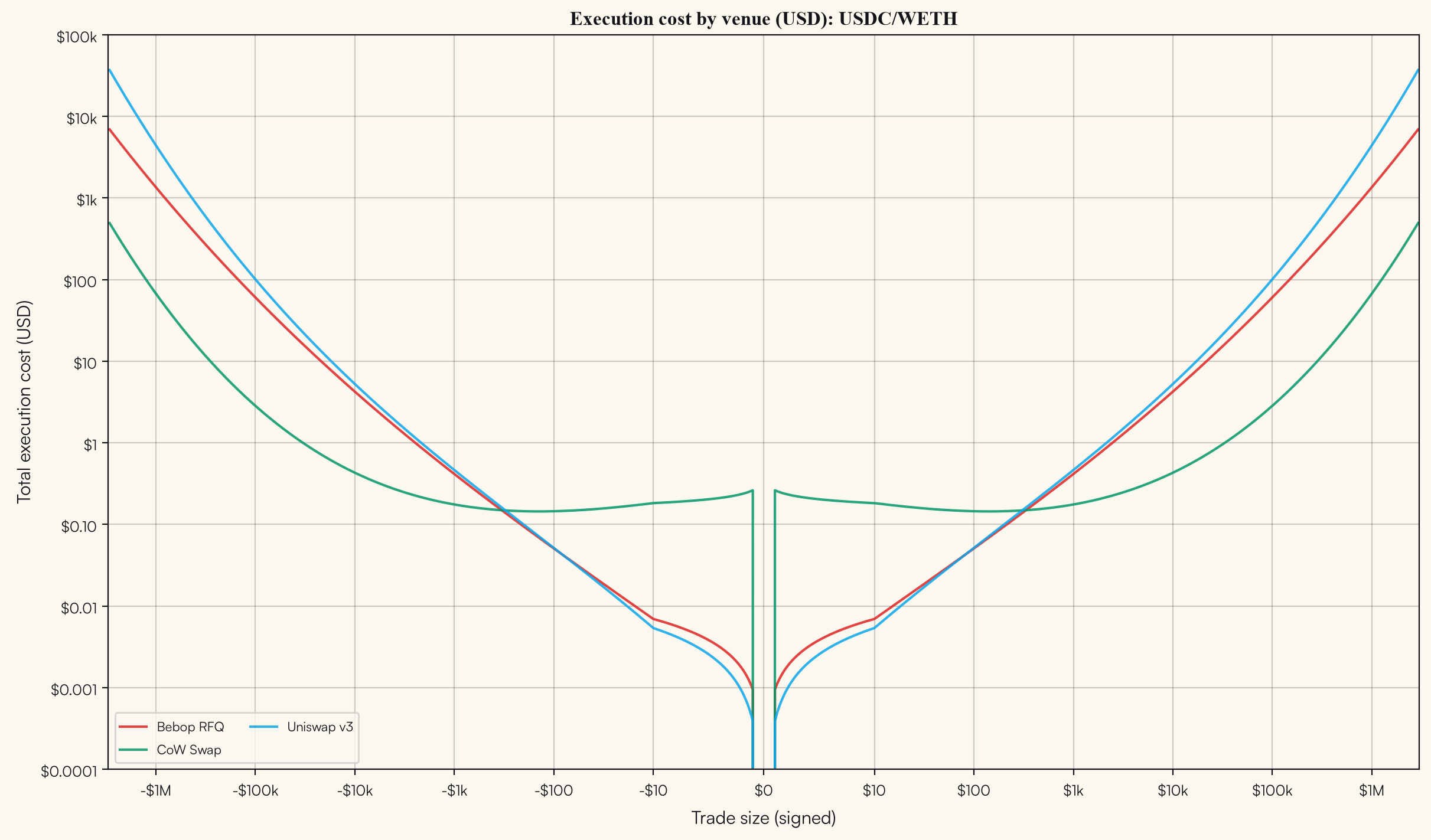
In absolute dollars, CoW offers the lowest execution bill at rebalance-relevant magnitudes; Bebop is a competitive RFQ alternative; Uniswap functions as the passive-liquidity reference point rather than the preferred route for this use case.
Internal Netting and Capital Efficiency
A manager operating a single vault in isolation bears the full liquidity cost of every external rebalance leg. Orion's multi-vault architecture permits internal netting: when one vault increases exposure to an asset and another decreases it, the offsetting flow is cancelled before it ever reaches external markets.
This is the onchain analogue of dealer-market internalization, where intermediaries first offset heterogeneous order flow within their own books and only externalize residual inventory to the broader market. Francis-Staite (2022) formalizes the multi-portfolio version of this, internal rebalancing processes that allocate assets between books before external trading, while Barzykin et al. (2021) models the equivalent dealer case. On shared Orion infrastructure, portfolios rebalancing against one another before reaching AMM liquidity is the mechanism.
The chart below shows aggregate system execution cost at varying netting efficiencies, the fraction of gross flow offset internally before it reaches external venues.
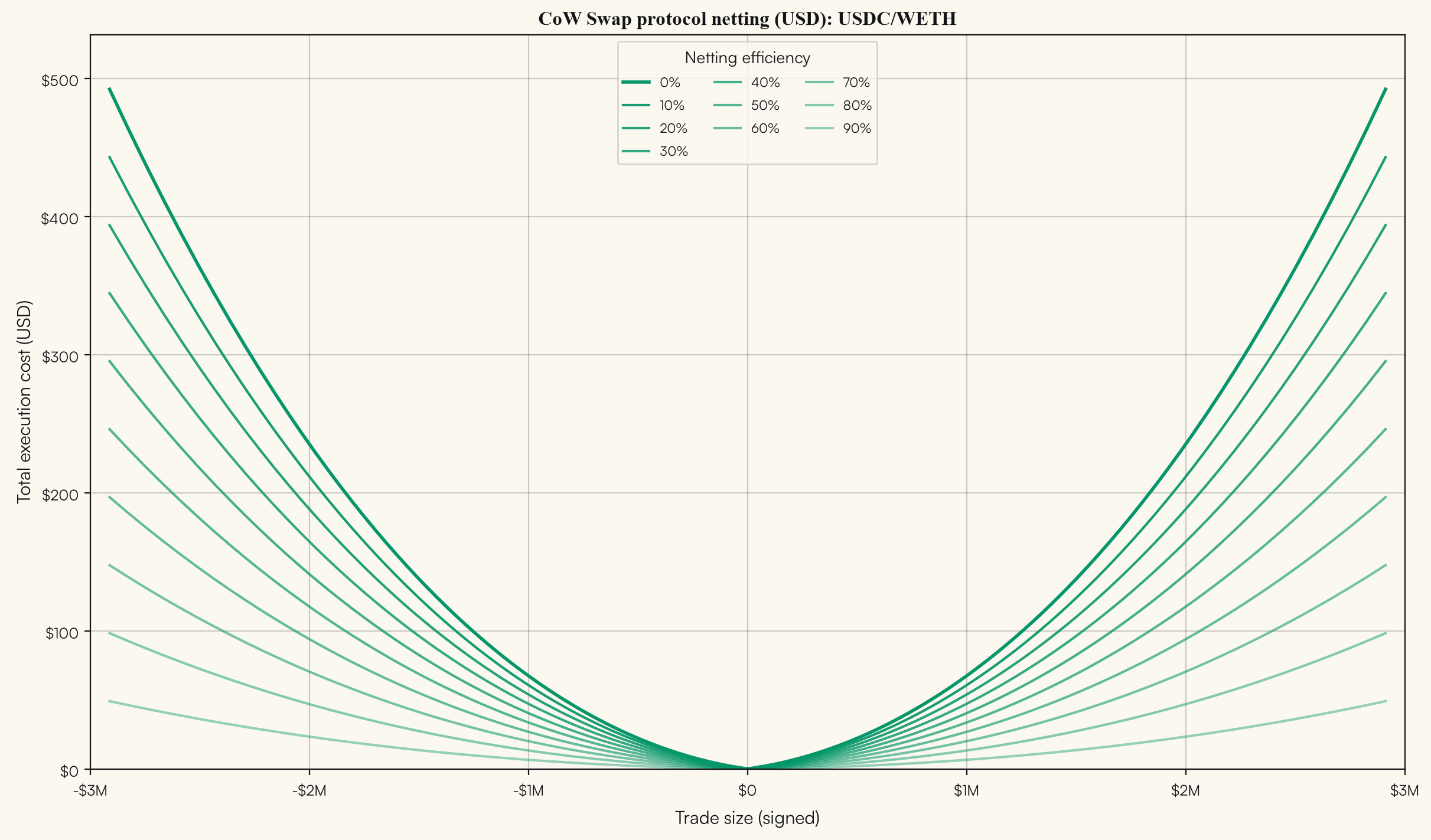
The vertical displacement between curves is the capital-efficiency gain attributable to shared infrastructure. At zero netting efficiency, the system pays full liquidity cost on gross flow. As internal offset increases, effective trade size against pool depth falls, and aggregate cost compresses toward a fraction of the isolated-vault level. Those gains are superlinear in η: residual notional scales with (1 − η), but because venue cost is convex in size, leaving the slippage tail compresses the bill faster than a linear volume reduction would imply.
Three implications follow for a manager evaluating this:
- Aggregate rebalance volume can grow without proportional execution drag, provided vaults under common management generate offsetting flow.
- Netting keeps effective trade size in the fee-floor region even when gross program size would otherwise enter the slippage tail.
- Multi-vault infrastructure converts correlated rebalancing needs into execution savings, so the aggregate platform can be more capital-efficient than the sum of independently operated vaults.
Implications for Portfolio Managers
| Cost layer | Operational character | Implication |
|---|---|---|
| Intent submission gas | Cents per rebalance | Immaterial relative to NAV |
| Venue routing (USDC/WETH) | Venue- and size-dependent | CoW preferred at rebalance-relevant scale |
| CoW netting | Superlinear compression in η | Material USD savings at moderate-to-high offset |
| Uniswap baseline | Fee floor + slippage | Passive reference only |
Relative to independently wired vaults, the same onchain liquidity can support lower effective execution cost and a cleaner separation between expression (intent) and achievement (liquidity).
Conclusion
Onchain portfolio management carries two execution costs with distinct drivers and different scaling properties.
For managers on Orion, gas is confined to intent submission and stays immaterial across the intent sizes and market conditions observed here. Liquidity cost is pool- and size-dependent, and competitive at deep onchain venues in the rebalance-relevant range. Netting across vaults further compresses aggregate cost, improving the economics of multi-strategy deployment relative to isolated rebalancing, an improvement that scales with how correlated a manager's own vaults are. Managers evaluating how this infrastructure fits into a broader product build may also find The ETP Issuer Stack, Onchain relevant background.
References
- Francis-Staite, K. (2022). Multi-portfolio internal rebalancing processes: Linking resource allocation models and biproportional matrix techniques to portfolio management. arXiv:2201.06183.
- Barzykin, A., Bergault, P., & Guéant, O. (2021). Algorithmic market making in dealer markets with hedging and market impact. arXiv:2106.06974.
- Uniswap Labs. Uniswap v3 Core.
Frequently Asked Questions
- What gas obligations does a manager incur on Orion?
- Intent submission only. Settlement and swap execution are handled downstream by the protocol and do not appear as a separate gas cost on the manager's side.
- Why not route everything through Uniswap?
- Uniswap provides continuous passive liquidity but convex slippage at size. RFQ (Bebop) and batch-auction (CoW) routes are typically more competitive for systematic flow in the rebalance-relevant notional range, though Uniswap remains a useful baseline for very small trades.
- What does netting efficiency mean operationally?
- η is the fraction of gross rebalance flow offset across vaults before residual flow reaches external venues. Residual notional scales by (1 − η), but because venue cost is convex in size, aggregate execution cost falls faster than that, so higher offset translates into superlinear savings.
- How does multi-vault netting affect execution cost?
- When vaults under common management generate offsetting flow, internal netting reduces the effective notional that reaches external venue depth. Aggregate liquidity cost falls accordingly, so a manager can run a larger gross rebalance program at lower per-dollar execution cost than isolated vaults would achieve on their own.
- Why deploy multiple strategies on shared Orion infrastructure rather than separately?
- Shared infrastructure converts correlated rebalancing needs into netting savings. Layer-1 gas economics are similar either way; the execution advantage accrues with strategy count and, more precisely, with the degree of offsetting flow across the vaults involved.
- Is CoW Swap always the cheapest venue?
- No. CoW Swap is U-shaped: at very small notionals, fixed overhead makes it relatively expensive in percentage terms, and Uniswap or Bebop can be more competitive at those sizes. CoW's advantage is concentrated in the rebalance-relevant notional band this analysis focuses on, not at every trade size.
- Does immaterial gas cost mean total execution cost is always low?
- No. Gas being immaterial only describes the intent-submission layer. Total execution cost still depends on venue routing and netting efficiency, both of which vary by pool, size, and how correlated a manager's vaults are with one another.