Onchain Rev-Share for Distributors
By recording each routed deposit with a durable distributorId onchain, Orion turns distributor rev-share into a query over public records: a transparent and verifiable statement per distributor, vault, and epoch.

By recording each routed deposit with a durable distributorId onchain, Orion turns distributor rev-share into a query over public records rather than bilateral reconciliation. The output is a transparent and verifiable statement per distributor, vault, and epoch.
How Attribution Works
The reference implementation is OrionDistributionRouter. A distributor integrates with the router directly, or through a front end that calls it.
- The end user approves the underlying asset and calls
requestDepositWithDistribution(vault, distributorId, assets). - The router verifies the vault is registered in
OrionConfig, pulls the assets from the user, and callsrequestDepositFor(user, assets)on the vault. - The router emits
DistributionDeposit(distributorId, vault, user, assets). - The deposit is queued by the vault for the next epoch, like any other deposit.
The event ties together four things: who routed the flow (distributorId), where it went (vault), whose flow it is (user), and how much (assets). Everything downstream is derived from that record.
Deposit-Level Attribution, Derived Accounting
The router tags the deposit. It does not need to tag every later event. Because the vault, the epoch, and the user are all recorded onchain, an indexer can follow the attributed user's position through subsequent epochs and attribute the fees that position generates to the distributor that brought it.
This keeps the router small and the attribution rule simple, while the rev-share logic lives in the indexer where it can be audited and replayed against onchain data. Anyone with access to the same events computes the same numbers.
Where the Revenue Comes From
The figure below shows how fees flow between the vault owner, the distributor, and the protocol.
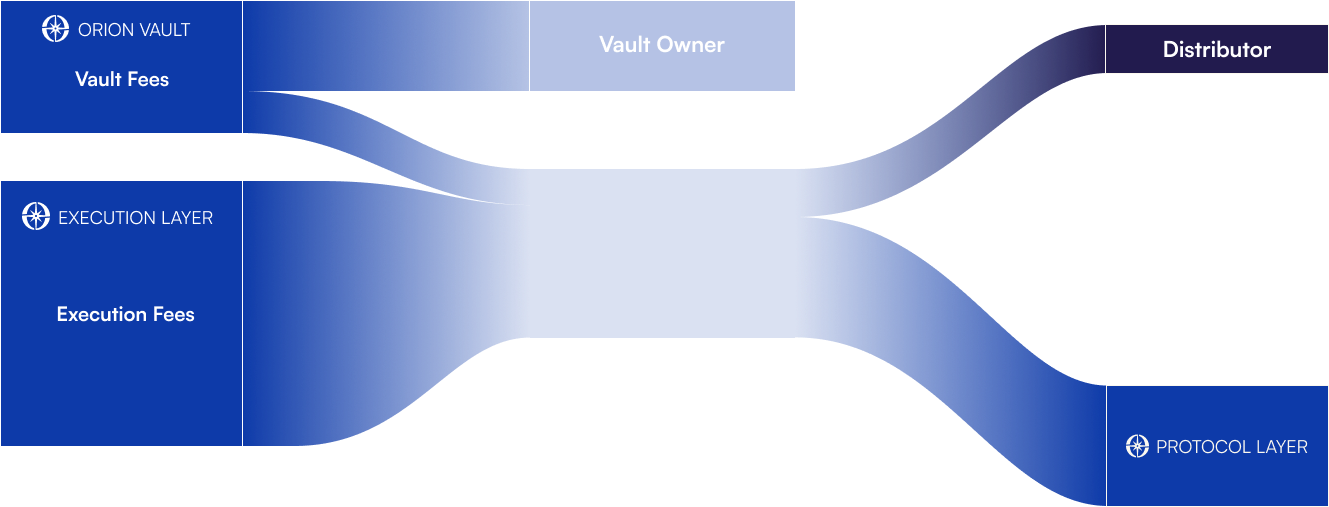
There are two sources.
- Vault fees are set by the vault owner. A slice of them is allocated to the shared pool; the rest stays with the vault owner.
- Execution fees are generated by the execution layer when it processes epoch flow. This is the larger source for distributors.
The shared pool is then split between the distributor and the protocol layer.
Execution Fees: Netting, Solver, and Brokerage
Execution fees are a mix of three streams, each tied to a different part of how Orion processes flow.
| Fee | What it pays for |
|---|---|
| Netting | Matching deposits and redemptions across vaults inside an epoch so that offsetting flow never trades. |
| Solver | Generating and verifying the orders needed to move the remaining net flow to the target portfolios. |
| Brokerage | Executing the residual orders against external markets. |
Internalization and Externalization
Orion rebalances many vaults in one batch. Flow that offsets across vaults is internalized: it is netted and never reaches a market. Flow that does not offset is externalized: it is routed to external liquidity.
Both generate execution fees, and a distributor shares in both. Internalization is typically the more valuable of the two, because it is the part of the flow the protocol can serve without paying for external liquidity. Every attributed deposit that grows the netting pool therefore improves the economics for the vaults it nets against, and for the distributor that brought it.
For more on the mechanics of netting, see Onchain Execution: Gas Costs, AMM Liquidity, and Netting in Multi-Vault Rebalancing. For how order generation is proven, see Verifiable Rebalancing at Scale.
Automatic Accounting
Once attribution is onchain, a distributor's statement is a computation over public data.
- Inputs:
DistributionDepositevents for the distributor, the vault and epoch records for each attributed position, and the fee records the protocol already emits. - Output: the vault-fee slice and execution fees attributable to the distributor, per vault and per epoch.
- Verification: the distributor, the vault owner, and the protocol can each reproduce the result independently.
There is no custom fee infrastructure to build around each interaction, and no reconciliation step between what a partner says it sent and what the protocol saw. Settlement of what is owed is currently handled offchain against this onchain record.
Who This Is For
- Wallets and neobanks shipping yield or portfolio products who need a revenue line that scales with assets they route, without changing the user's deposit path beyond the router call.
- Fintechs and CASPs running white-label books who need an auditable record of which clients entered through which channel.
- Aggregators and allocators that originate flow across many vaults and want fee share tied to that origin.
- Vault managers who want distribution partners and a transparent way to share vault fees with them, under the same access-control rules as direct deposits.
Access Control Still Applies
Distribution routing does not bypass vault access control. When the router calls requestDepositFor, the vault runs the same _requireCanRequestDeposit path as a direct deposit: both canRequestDeposit and canHoldShares must pass for the beneficiary. At fulfillDeposit, the vault re-checks canHoldShares before minting shares.
A distributor therefore cannot be used to route flow into a vault that would reject the same user directly. See Modular Permissioning for Onchain Vaults.
References
- Orion Finance Research. Modular Permissioning for Onchain Vaults.
- Orion Finance Research. Onchain Execution: Gas Costs, AMM Liquidity, and Netting in Multi-Vault Rebalancing.
- Orion Finance Research. Verifiable Rebalancing at Scale: Trustless Order Generation Without Onchain Cost.
- Orion Finance.
OrionDistributionRouter.
Frequently Asked Questions
- What does a distributor need to integrate?
- A distributor, or the front end it operates, calls
requestDepositWithDistribution(vault, distributorId, assets)on the distribution router instead of depositing into the vault directly. The user approves the underlying asset and the router does the rest. - What does the router record?
- It emits
DistributionDeposit(distributorId, vault, user, assets), tying a deposit to the distributor that routed it. Offchain indexers use that event as the starting point for attribution. - Are rev-share payouts made onchain?
- No. Attribution is onchain today. The calculation of what each distributor is owed is derived from that record, and settlement is handled offchain.
- Does the distributor have to add its own fee?
- No. The distributor's revenue comes from a share of fees the protocol already collects on the flow it routes: a slice of vault fees and execution fees. Nothing needs to be added to the user's transaction.
- Which fees does a distributor share in?
- A slice of vault fees, and execution fees (netting, solver, and brokerage) on the flow it attributes. Execution fees are the main source of distributor revenue.
- Does a distributor earn on flow that is netted internally?
- Yes. Both internalized flow (netted across vaults) and externalized flow (routed to markets) generate execution fees.
- Does routing through a distributor bypass vault access control?
- No. The vault applies the same
canRequestDepositandcanHoldShareschecks to the beneficiary as for a direct deposit, and re-checkscanHoldSharesbefore minting shares atfulfillDeposit.